
Folding door vs sliding door comes down to one question: do you need the whole opening clear, or the largest possible panels on a wide span? Choose a folding door (PIEGA) when the wall must open almost completely and the leaves can stack at the side. Choose a sliding door (AGIO lift-and-slide) when you want big sashes, thick insulated glass and no swing into the room.
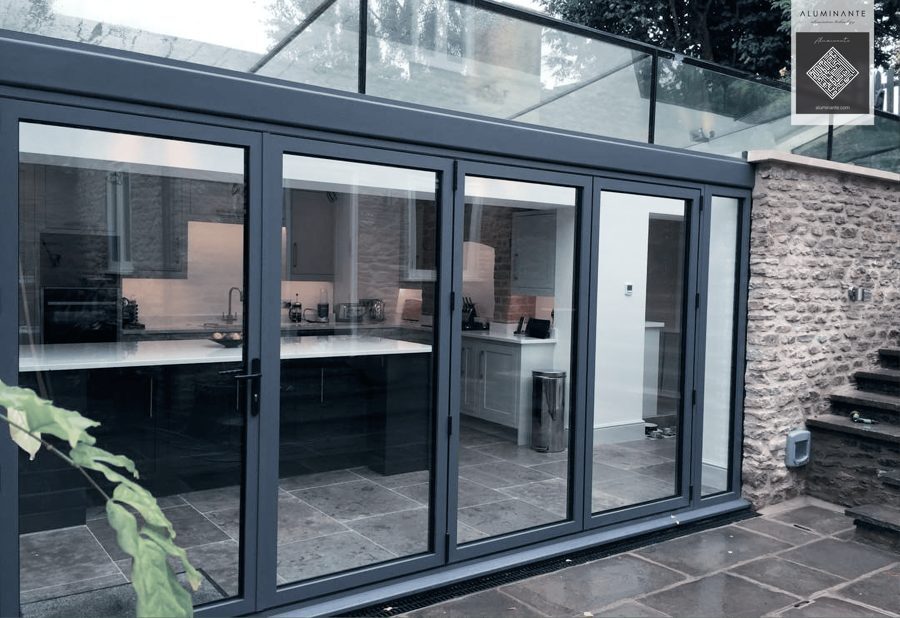
Folding door vs sliding door at a glance
Both systems cover openings up to 18 m (59 ft). They get there in different ways, so the table compares the two Aluminante systems that fit this choice.
| Feature | Folding door: PIEGA | Sliding door: AGIO lift-and-slide |
|---|---|---|
| How it opens | Leaves fold and stack to one or both sides | Sashes slide on 1, 2 or 3 tracks |
| Max opening | Up to 18 m wide with 9 + 9 sashes | 18 000 × 3 000 mm (59 × 10 ft) |
| Configurations | 3 to 9 wing configurations | Up to 6 sashes in one system |
| Sash size | Up to 1 200 × 3 000 mm (4 × 10 ft); recommended width 700 mm (2.3 ft) | 500 to 3 000 mm wide, 1 200 to 3 000 mm high (up to 3 000 × 3 000 mm) |
| Max sash weight | 100 kg (220 lb), recommended | Up to 400 kg (880 lb) with glazing |
| Clear opening | 85% | Part of the opening stays covered by overlapping sashes |
| Glass | 4 to 40 mm | Insulated glass units from 6 mm, up to 54 mm in the Massimo 155 series |
| Insulation | Cold or warm series, 16 mm thermal bridge, Uf 2.25 W/m²K | 34 mm thermal break, Uw 1.07 and Uf 1.83 W/m²K |
| Threshold | High or low; can be recessed into the floor | — |
| Hardware | GU, Germany | GU / SIEGENIA, Germany |
| Warranty | 10 years | 10 years |
Specifications are from the PIEGA and AGIO product pages.
Which is better, sliding doors or bifold?
Neither wins everywhere. Bifold is better when the opening itself matters most. Sliding is better when the sash size and the glass matter most.
A folding door gives you a clear opening of 85%, because the leaves collapse into a stack at the side. The trade-off is a stack of leaves beside the opening. A sliding door keeps its sashes in line with the wall. You never lose floor space to a swing or a stack, but overlapping sashes always cover part of the opening.
Bifold door vs sliding door: how do they differ in daily use?
Opening and clear view
PIEGA hides its rollers and hinges inside the upper and lower guides, so an open wall shows no overhead hardware. In a 9 + 9 layout, the whole 18 m span folds to both ends. AGIO sashes are interconnected, so pushing the first sash closes the whole system.
Sash size and weight
AGIO carries much more per sash: up to 3 000 × 3 000 mm and up to 400 kg with glazing. PIEGA works with narrower leaves, up to 1 200 mm wide, and a recommended leaf of 700 mm and 100 kg. Narrow leaves are why a folding door shows more vertical frames when it is closed.
Heat and sealing
Both systems are available with thermal insulation. PIEGA is available in a cold series and a warm series with a 16 mm polyamide thermal bridge, with four-layer EPDM seals. AGIO has a 34 mm thermal break, seals between sashes and integrated condensate drainage. AGIO has the lower frame value (Uf 1.83 against 2.25 W/m²K) and a rated Uw of 1.07 W/m²K.
Entry and security
With PIEGA, the last leaf can work as a permanent entrance door, and a swing door option opens inward or outward. Anti-burglar fittings are part of the system. This matters on a restaurant front, where a door is used all day while the rest of the wall stays closed.
Bifold doors vs patio doors: what is a patio door here?
In North America, a patio door usually means a sliding door. In this article, the sliding choice is AGIO, a lift-and-slide system. Its sashes run on one, two or three tracks. A single track suits a standard opening, a double track suits wider openings, and a triple track suits a panoramic wall.
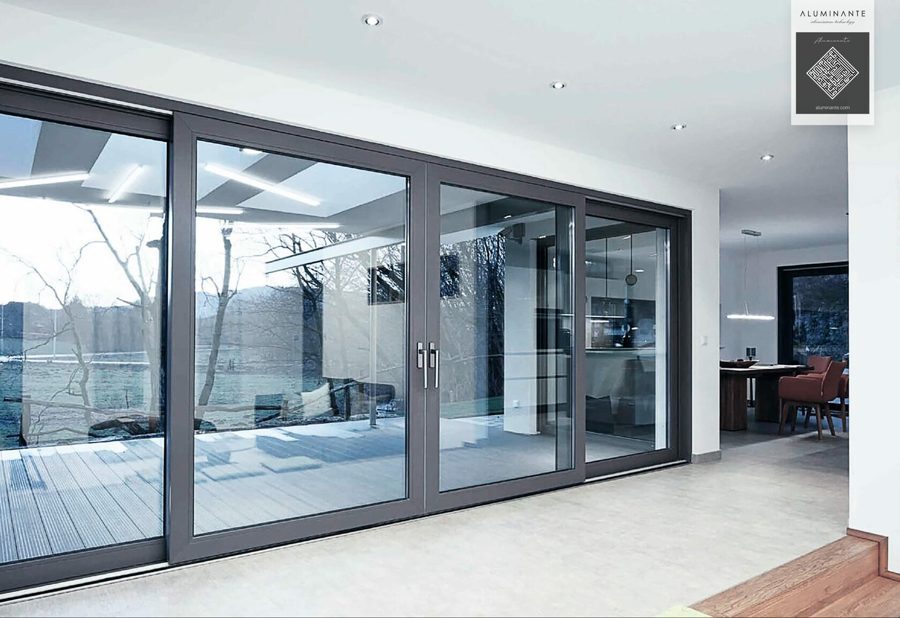
Multi sliding patio doors vs bifold: which handles a wide wall?
Both do. A multi-track sliding wall reaches 18 000 mm (59 ft) with up to 6 sashes, with no additional supporting beams. A folding wall reaches the same 18 m with up to 9 + 9 sashes. The difference is the sash. Six large sashes sit in front of each other when open. Folding leaves stack at the ends.
If your drawings show a full-width opening with no obstruction, check where the stacks can go. If they show one large view, check the sash size.
How much is a folding glass door?
The cost of folding glass doors depends on the opening, so we calculate each project from drawings or specs.
Bifold door vs sliding door cost: what moves the total
The same factors apply to both doors. Opening width and height set how much glass and aluminum go into the order. The number of leaves, the glass thickness, the series (cold or warm for PIEGA, Tuba, Standard 125 or Massimo 155 for AGIO), the threshold type and the color all change the quote.
For a full price breakdown of a glass wall project, see our article on frameless glass patio enclosure cost.
Frameless folding and sliding walls: when do they make sense?
If you want panels with no vertical profiles between them, framed doors are not the answer. SPAZIO is our frameless folding glass wall, up to 20 m wide, with 8 to 10 mm tempered panels that fold and stack to the sides. ORIZZONTE is the frameless sliding option, with panels up to 3 500 mm high. Both are for seasonal spaces. They are not insulated. See the SPAZIO page for details.
Which one fits your project
Private villa
If the terrace faces a view and the sashes should be as large as possible, AGIO gives you 3 000 mm wide sashes and thick insulated glass. If the living room should become part of the garden for the summer, PIEGA opens 85% of the wall.
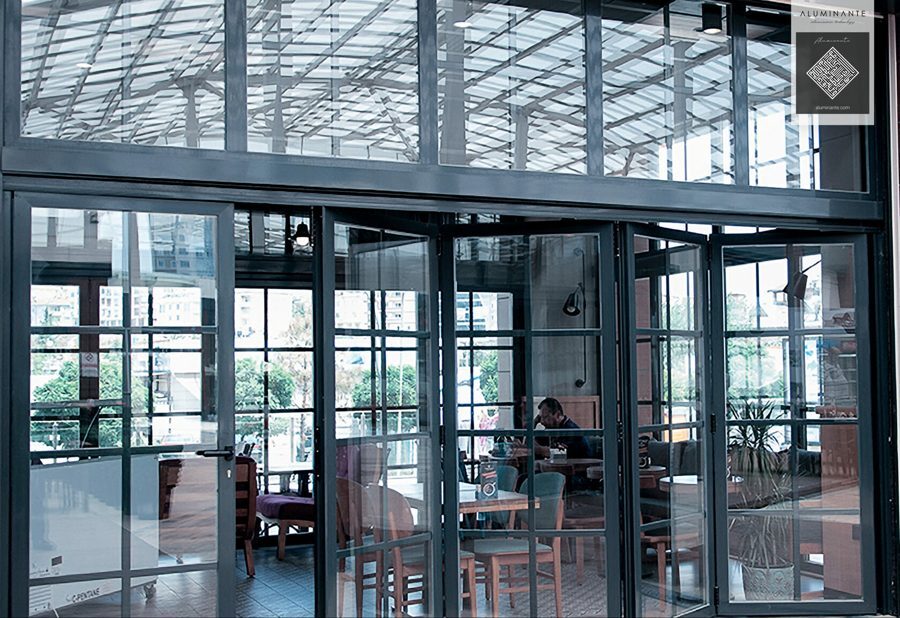
Restaurant or hotel
PIEGA is the system for restaurants, cafes and recreation areas: the front opens in full for service in good weather, and one leaf stays in use as an entrance door. The warm series is available for cooler months.
Contractor on a multi-unit project
For repeated units, pick by the opening: a standard wall with one large view, AGIO; a wide wall that must clear completely, PIEGA. Send the list of openings, and we calculate the whole batch. Production takes 10–14 days, and a container to the US or Canada takes 28–32 days. We ship finished systems or profiles.
Have a project? Send drawings or specs, we'll calculate it.
WhatsApp: +90 539 574 18 23 · Email: tr@aluminante.com
Why Aluminante
- We develop and manufacture the systems, so one supplier covers doors, glazing, pergolas and screens for the same project.
- Both PIEGA and AGIO carry German hardware (GU, and SIEGENIA on AGIO).
- Projects are calculated from drawings or specs.
- Production in 10–14 days, then 28–32 days by container to the US or Canada.
- 10-year warranty on all systems.
FAQ
Are bifold doors better than sliding doors?
Bifold doors clear 85% of the opening, sliding doors carry much larger sashes. The better door depends on whether you need the full opening or the large sash.
How wide can a folding door or sliding door be?
PIEGA reaches 18 m wide (9 + 9 sashes). AGIO reaches 18 000 × 3 000 mm with up to 6 sashes and no additional supporting beams.
Can the door be insulated for cold winters?
Yes. PIEGA comes in a warm series with a 16 mm thermal bridge. AGIO has a 34 mm thermal break and takes insulated glass units up to 54 mm in the Massimo 155 series.
Can I choose the color?
Yes. PIEGA can be painted or anodized in any RAL color, with wood-look decorative options. AGIO can be painted in any RAL color.

